Is Investing in Indianapolis Rental Demand Neighborhoods Worth It?
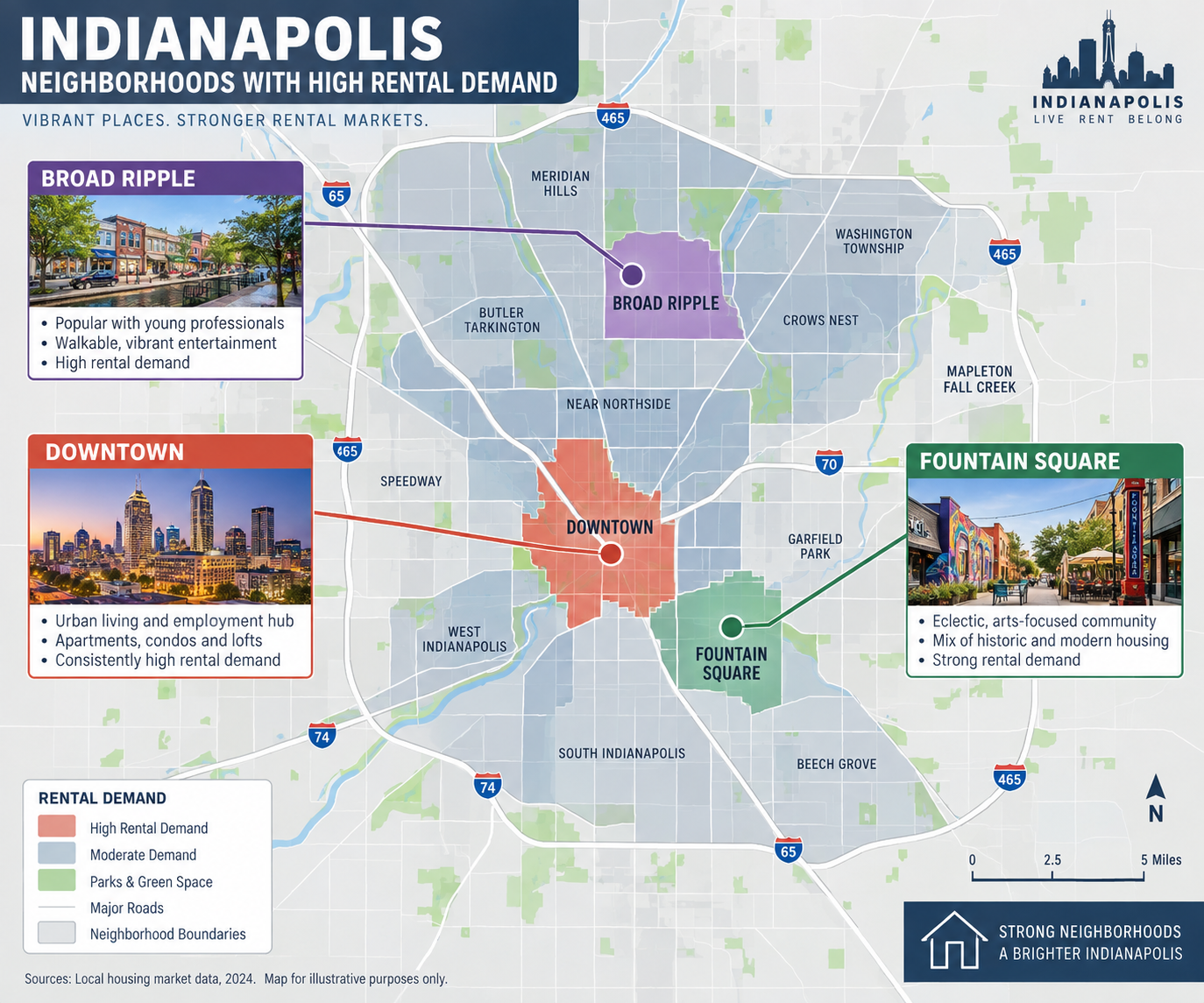
Yes, investing in Indianapolis rental demand neighborhoods is worth it—if you target areas near Indiana University-Purdue University Indianapolis (IUPUI), IndyGo transit corridors, or active gentrification zones like Fountain Square and Near Eastside. According to Zillow and RentCafe data, Indianapolis Metropolitan Statistical Area median rent sits at $1,285/month, with select neighborhoods posting occupancy rates above 95%. Indianapolis remains one of the few mid-size Midwest metros where rental yield still exceeds 7% while median home values stay below $250,000 in most target submarkets. This guide breaks down exactly where rental demand is strongest, what it costs to invest, how returns compare across neighborhoods, and who should skip it entirely.
What You Get When Investing in Indianapolis Rental Demand Neighborhoods
Understanding which Indianapolis neighborhoods have the highest rental demand requires layered market data, not just a single rent comp. Here’s what’s included in a thorough Indianapolis neighborhood guide versus what falls outside standard research and requires separate due diligence.
Included in Rental Market Analysis
- Vacancy rate data — Apartment List tracks apartment vacancy rate trends by ZIP code, updated quarterly, allowing investors to compare Fountain Square’s sub-5% vacancy against citywide averages near 7.4%
- Median rent benchmarks — Realtor.com and Zillow provide rental comps updated monthly, broken out by unit size (studio, one-bedroom, two-bedroom)
- Population growth metrics — U.S. Census data shows Indianapolis MSA grew 1.8% between 2020-2024, outpacing the Midwest regional average of 0.9%
- Tenant demand indicators — days-on-market and applicant volume per listing, which in Fletcher Place average under 12 days versus a 21-day metro median
- Job market growth correlation — proximity to downtown employers, Eskenazi Health, IU Health, and Lilly Corporate Center campuses
- Neighborhood-level crime and school data — often bundled into full property reports to help investors screen tenant pools
Extras Not Included (Requires Additional Research)
- Property management fees (typically 8-12% of rental income, plus a one-time leasing fee equal to 50-100% of first month’s rent)
- Renovation or turnover costs between tenants, which in older Fountain Square or Irvington housing stock can run $3,000-$8,000 per unit
- Landlord insurance and property tax variations by township — Center Township rates differ from Washington or Warren Township assessments
- Section 8 or affordable housing compliance costs, relevant in Garfield Park and parts of Near Eastside
- HOA or historic district renovation restrictions, common in Herron-Morton and Meridian-Kessler
Investors who skip this second category often underestimate true carrying costs by 15-20% in their first year of ownership.
Cost Breakdown: Indianapolis Rent Prices by Top Rental Demand Neighborhoods
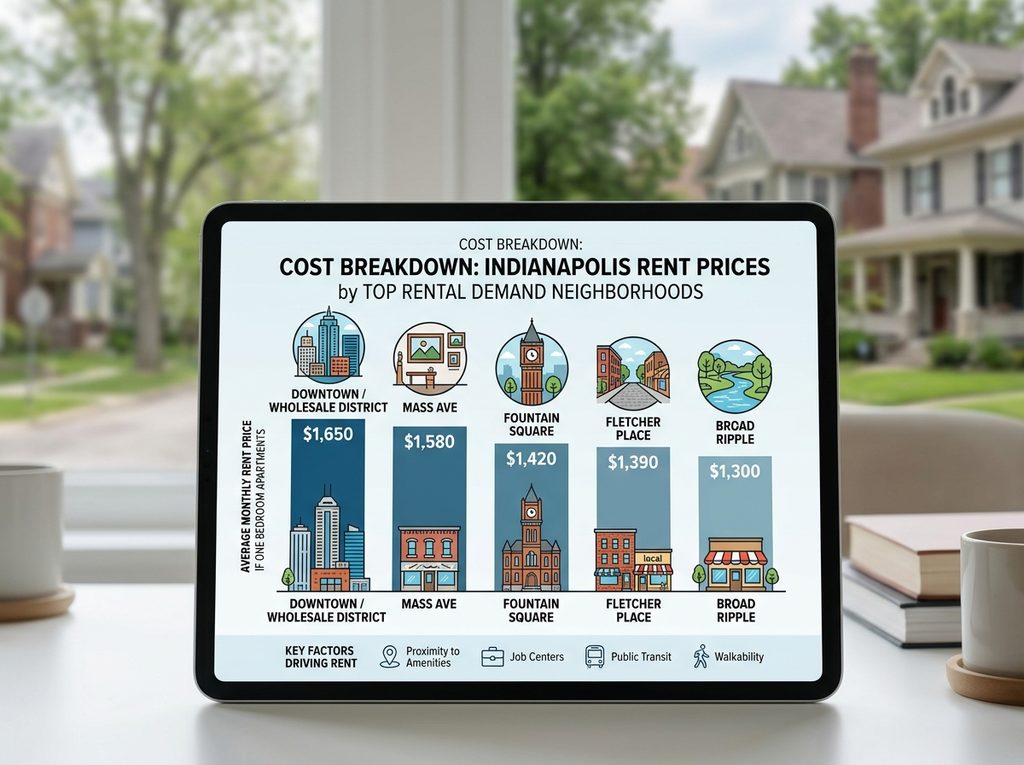
Housing affordability varies significantly across Indianapolis neighborhoods, sometimes by more than $600/month in median rent within a five-mile radius. Below is a cost snapshot for the strongest rental demand areas in Indianapolis.
| Neighborhood | Median Rent | Median Home Value | Occupancy Rate |
|---|---|---|---|
| Fountain Square | $1,395/mo | $225,000 | 96% |
| Broad Ripple | $1,450/mo | $265,000 | 95% |
| Fletcher Place | $1,520/mo | $285,000 | 97% |
| Mass Ave | $1,610/mo | $310,000 | 96% |
| Irvington | $1,180/mo | $195,000 | 93% |
| Herron-Morton | $1,275/mo | $240,000 | 94% |
| Garfield Park | $1,050/mo | $165,000 | 91% |
| Downtown Indianapolis | $1,680/mo | $320,000 | 94% |
Data sourced from Zillow, Realtor.com, and RentCafe. Median rent figures reflect one-bedroom units; multifamily housing rates vary by 8-15% depending on unit mix and building age.
Why These Indianapolis Neighborhoods Have Highest Rental Demand
Fletcher Place and Mass Ave lead in occupancy rate largely due to walkability and proximity to downtown employment, with both neighborhoods sitting within a 15-minute walk of the Cultural Trail. Fountain Square’s rental price growth of 6.2% year-over-year (RentCafe) reflects ongoing urban renewal and gentrification pressure, driven partly by new mixed-use development along Virginia Avenue. Butler-Tarkington and Meridian-Kessler show steadier, lower-volatility rental yield patterns favored by long-term landlords seeking cash flow properties over speculative appreciation—rent growth in these areas trails downtown submarkets by roughly 2 percentage points annually but comes with fewer vacancy swings.
Downtown Indianapolis commands the highest median rent on this list but also carries the highest entry price, meaning gross yield often runs 1-2 points lower than in Fountain Square or Irvington despite stronger nominal rent.
Expected Benefits & ROI Analysis for Indianapolis Real Estate Investing
Rental yield across Indianapolis outperforms many comparable Midwest markets. According to an Apartment List market analysis, gross rental yield in high-demand Indianapolis neighborhoods ranges from 7% to 9.5%, compared to a national average near 5.8%.
Key ROI Drivers
- Property appreciation — Fountain Square and Near Eastside have appreciated 18% since 2022 due to gentrification-driven demand, outperforming the metro-wide appreciation rate of roughly 11% over the same period
- Rental income stability — Broad Ripple and Meridian-Kessler maintain low vacancy rates (under 6%) tied to consistent tenant demand from young professionals and dual-income renters
- Cash flow properties — Garfield Park and Irvington offer lower entry costs with rental yields exceeding 8%, ideal for cash-flow-focused investors working with $150,000-$200,000 acquisition budgets
- Transit-driven demand — Properties near IndyGo rapid transit lines see 10-15% higher tenant retention (IndyGo ridership data, 2024), reducing turnover costs and vacancy loss
As a practical example: a $195,000 Irvington duplex renting at $1,180/month per unit generates roughly $28,320 in gross annual rent. After a conservative 40% expense ratio (taxes, insurance, management, maintenance), net operating income lands near $17,000—a 8.7% cash-on-cash yield before financing costs, consistent with the yield range reported by Apartment List for this submarket.
For investors comparing multiple submarkets, reviewing Indianapolis rental demand neighborhoods data side-by-side helps identify where occupancy rate and rental price growth intersect most favorably.
Who Should Invest in Indianapolis Rental Property?
Good Fit For:
- Investors seeking cash flow properties with yields above 7%
- Landlords targeting IUPUI student housing near Downtown Indianapolis, where demand cycles align predictably with academic calendars
- Buyers comfortable with gentrification-adjacent neighborhoods like Fountain Square or Near Eastside, and willing to accept some near-term renovation exposure
- Long-term holders wanting property appreciation in emerging areas, with a minimum 3-5 year investment horizon
- Out-of-state investors using Indianapolis property management services for hands-off ownership, since local management firms are well-established and competitively priced relative to coastal markets
- Low-to-mid capital investors ($150,000-$250,000) who want exposure to a growing metro without coastal-market entry prices
Poor Fit For:
- Investors requiring instant liquidity (Indianapolis real estate is not highly liquid short-term, with typical days-on-market for resale near 35-45 days)
- Those unwilling to manage tenant turnover in higher-demand, younger-renter neighborhoods like Fletcher Place or Mass Ave
- Buyers seeking Class-A luxury yields matching coastal markets — Indianapolis is a yield-and-stability play, not a high-appreciation speculative market
- First-time landlords without a property management plan in unfamiliar areas like Speedway, where local knowledge of tenant pools matters more than in established neighborhoods
- High-capital investors expecting rapid, double-digit annual appreciation citywide rather than in select submarkets
Alternatives to Consider Beyond Core Indianapolis Neighborhoods
Not every investor needs to compete in Mass Ave or Fletcher Place pricing tiers. Consider these alternatives if entry costs or competition in top-tier neighborhoods feel prohibitive:
- Suburban Indianapolis submarkets — Lower entry cost, slower but steadier rental price growth; areas like Beech Grove and Lawrence offer median home values under $180,000
- Speedway — Emerging tenant demand tied to motorsports-adjacent employment, lower median home values, and less competition from institutional buyers
- Multifamily REITs — Passive exposure to Indianapolis multifamily housing without direct property management, though with lower control over individual asset selection
- Other Midwest metros — Columbus or Kansas City offer comparable rental yield with different population growth trajectories; Columbus posted stronger 2020-2024 population growth (4.1%) while Kansas City offers lower median entry prices
Final Verdict: Is It Worth Investing in Indianapolis Rental Demand Neighborhoods?
Indianapolis rental property investment is worth it for investors prioritizing cash flow, moderate appreciation, and manageable entry costs. The strongest rental demand areas in Indianapolis—Fletcher Place, Mass Ave, Fountain Square, and Broad Ripple—combine high occupancy rate performance with measurable rental price growth documented by Zillow, Realtor.com, and RentCafe throughout 2024-2025.
Neighborhood Ranking for Rental Investment
| Rank | Neighborhood | Best For | Est. Gross Yield |
|---|---|---|---|
| 1 | Fletcher Place | Occupancy stability + appreciation | 7.8% |
| 2 | Fountain Square | Appreciation-focused investors | 7.4% |
| 3 | Irvington | Low-capital cash flow | 8.7% |
| 4 | Garfield Park | Highest yield, higher management effort | 9.2% |
| 5 | Broad Ripple | Low-vacancy stability | 7.1% |
| 6 | Mass Ave | Premium tenant demand, higher entry cost | 6.9% |
| 7 | Herron-Morton | Balanced yield and appreciation | 7.3% |
| 8 | Downtown Indianapolis | IUPUI-adjacent renter demand | 6.6% |
For budget-conscious investors, Irvington and Garfield Park remain among the best Indianapolis suburbs for rental income, offering higher yields at lower purchase prices. Meanwhile, Downtown Indianapolis and Near Eastside suit investors betting on continued urban renewal momentum, even at a somewhat compressed yield relative to lower-cost neighborhoods.
Bottom line: If you can commit to active or professionally managed property oversight and hold for 3+ years, Indianapolis’s rental market trends support a favorable risk-adjusted return. Match your neighborhood choice to your investment goal—cash flow investors should prioritize Garfield Park and Irvington, while appreciation-focused investors should look toward Fountain Square and Fletcher Place.