
What Is an Indiana Landlord’s Legal Responsibilities? A Complete Compliance Guide
Indiana landlord legal responsibilities are the statutory duties property owners must follow under Indiana Code Title 32, Article 31, covering habitability, security deposits, notice requirements, and fair housing compliance.
These landlord obligations exist to protect tenant rights while giving property owners a clear legal framework for managing rental property. Understanding Indiana landlord-tenant law reduces disputes, limits liability, and keeps landlords out of Indiana Small Claims Court. Whether you own a single duplex in Fort Wayne or manage a 200-unit portfolio in Indianapolis, the same statutory baseline applies: every residential lease in Indiana is governed by these minimum standards, and lease clauses that attempt to waive them are generally unenforceable.
Why Indiana Landlord Responsibilities Matter
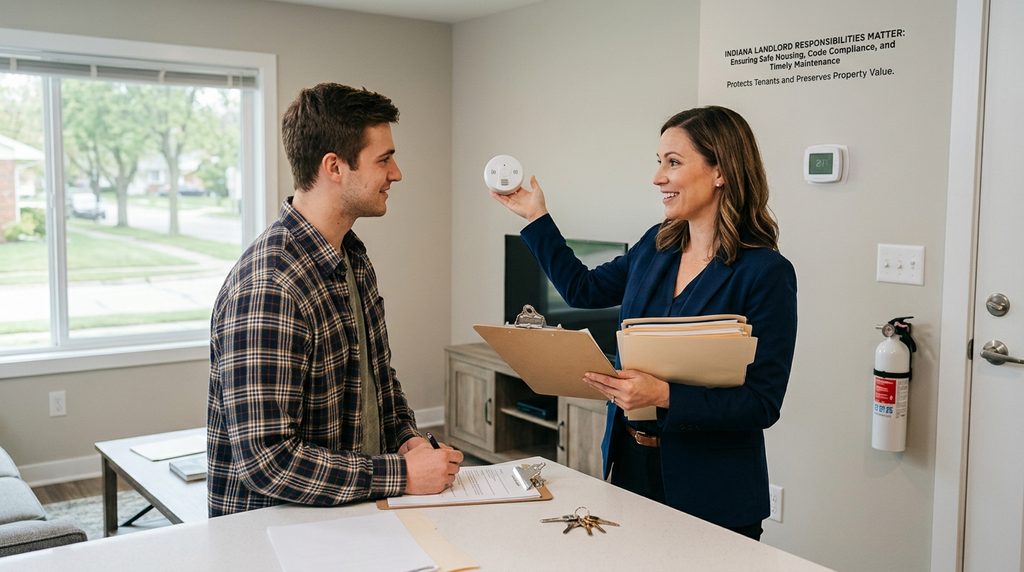
Non-compliance with Indiana rental laws can result in lawsuits, fines, or forced lease termination. According to Indiana Code § 32-31-8-5 (2025), landlords who fail to maintain habitable conditions risk tenant-initiated legal remedies, including rent withholding or lease cancellation.
Landlords who understand their legal duties avoid costly litigation and maintain compliant, profitable rental portfolios. Beyond avoiding lawsuits, compliance also protects a landlord’s business reputation—unresolved habitability complaints often surface in online reviews, local news coverage, and health department public records, which can affect future tenant applications and property valuation. For a broader overview of Indiana landlord responsibilities, property owners can consult specialized resources before drafting lease terms.
Compliance also matters for financing and insurance. Many mortgage lenders and landlord insurance carriers require proof of code compliance and proper lease documentation before issuing or renewing coverage, making statutory knowledge a practical business necessity, not just a legal formality.
Key Characteristics of Indiana Landlord Legal Responsibilities

1. Habitability Requirements
Indiana’s implied warranty of habitability requires landlords to maintain safe, livable conditions throughout the tenancy. This is a core component of habitability standards under Indiana Code § 32-31-8-5. Habitability covers functioning heating systems during winter months, potable running water, structurally sound floors and stairways, and weatherproof roofing and windows. A landlord who ignores a broken furnace for weeks during an Indiana winter, for example, is likely violating this warranty regardless of what the lease states.
2. Security Deposit Law Indiana
Indiana Code § 32-31-3 governs security deposit handling. Landlords must return deposits—or an itemized deduction list—within 45 days after lease termination. Permissible deductions include unpaid rent, unpaid utility charges the tenant owed, and damage beyond normal wear and tear, such as broken windows or torn carpet caused by pets. Normal wear, like minor scuffing on walls or faded paint from sunlight, cannot be deducted. Landlords who fail to comply may be liable for the withheld amount plus additional damages if a court finds bad faith.
3. Notice Requirements
Indiana law mandates specific notice periods for entry, lease termination, and notice to quit before eviction proceedings begin. Notice periods vary by violation type: nonpayment of rent typically triggers a shorter cure period than a lease violation unrelated to rent, and notice must be delivered in a manner the lease or statute recognizes—commonly in writing, hand-delivered or posted conspicuously on the unit.
4. Fair Housing Compliance
Landlords must comply with the federal Fair Housing Act, prohibiting discrimination based on race, color, religion, sex, national origin, familial status, or disability. This obligation extends to advertising language, tenant screening criteria, and reasonable accommodation requests—such as allowing a service animal despite a no-pet policy or installing a wheelchair ramp at the tenant’s expense.
5. Property Maintenance Obligations
Ongoing rental property maintenance duties include structural repairs, pest control, and functioning utilities. This also includes maintaining common areas in multi-unit buildings—stairwells, hallways, and shared laundry facilities—in a safe, code-compliant condition, and promptly addressing recurring maintenance requests before they escalate into habitability violations.
How Indiana Landlord Responsibilities Work: Step-by-Step
Step 1: Before Tenant Moves In
- Draft a compliant lease agreement outlining rental agreement terms, including rent amount, due date, late fees, and maintenance responsibilities
- Conduct legal tenant screening without violating fair housing laws—apply the same criteria (credit, income, rental history) to every applicant
- Complete a move-in inspection and document existing conditions with photos, video, and a signed checklist both parties retain
- Install working smoke detectors in every rental unit, per Indiana Code § 22-11-18, and test them before handing over keys
- Disclose required information (lead paint, flooding history, if applicable)—part of required disclosures landlords must provide before signing
Step 2: During the Tenancy
- Maintain habitable living conditions, including heating, plumbing, and electrical systems, responding to repair requests within a reasonable timeframe (often 48-72 hours for urgent issues)
- Handle tenant complaints promptly and document responses in writing, including dates and actions taken
- Follow Indiana law on landlord entry notice—reasonable notice (typically 24–48 hours) before entering occupied units, except in genuine emergencies like a gas leak or fire
- Address pest control landlord responsibility and mold remediation landlord duty when conditions affect habitability, especially in multi-unit buildings where infestations spread between units
- Clarify utility responsibilities landlord obligations in the lease agreement—specify which utilities the landlord pays versus the tenant to avoid disputes over shutoffs
Step 3: Lease Termination and Move-Out
- Provide proper notice requirements for lease termination (typically 30 days for month-to-month leases)
- Conduct a move-out inspection comparing to move-in documentation, ideally with the tenant present to reduce disputes
- Process security deposit return within 45 days, per Indiana Code § 32-31-3-12
- Provide itemized deduction statements for any withheld amounts, including repair invoices or receipts when possible
Step 4: Eviction Process (If Necessary)
- Issue a formal notice to quit stating the violation and cure period, delivered according to statutory requirements
- File eviction paperwork in the appropriate Indiana court if tenant doesn’t comply within the cure period
- Attend court hearing—many cases proceed through Indiana Small Claims Court, where landlords should bring the lease, notice copies, payment records, and photos of any damage
- Obtain a court order before removing tenant or belongings; only a sheriff or authorized law enforcement officer may execute the physical eviction
Self-help evictions (changing locks, removing belongings without court order) are illegal under Indiana law and can expose landlords to tenant lawsuits, including claims for damages, attorney’s fees, and even punitive damages in egregious cases.
Common Misconceptions About Indiana Landlord Responsibilities
| Myth | Reality |
|---|---|
| Landlords can keep the entire security deposit for any reason. | Indiana law requires itemized deductions; only unpaid rent or damage beyond normal wear qualifies. |
| Landlords can evict tenants immediately for late rent. | Indiana requires a written notice to quit and court-approved eviction process—no self-help evictions allowed. |
| Habitability only means the unit has four walls and a roof. | Habitability standards require functioning heat, plumbing, electricity, and structural safety. |
| Verbal leases aren’t legally binding in Indiana. | Verbal leases under one year can be enforceable, though written agreements are strongly recommended. |
| Landlords can retaliate against tenants who file complaints. | Landlord retaliation—such as eviction after a habitability complaint—is illegal under Indiana Code § 32-31-9. |
These misconceptions often stem from confusion with other states’ landlord-tenant statutes, which can differ significantly from Indiana’s requirements. Landlords who operate rental properties in multiple states should verify obligations separately for each jurisdiction rather than assuming uniform rules apply nationwide.
Landlord Responsibilities vs. Tenant Responsibilities
Unlike tenant duties—paying rent on time and maintaining cleanliness—landlord duties center on structural upkeep, safety compliance, and legal notice obligations. This division of responsibility is designed so that neither party bears the full burden of property upkeep, and each side has enforceable remedies when the other fails to meet its obligations.
| Landlord Responsibilities | Tenant Responsibilities |
|---|---|
| Maintain habitability requirements | Keep unit clean and sanitary |
| Handle property repairs for major systems | Report needed repairs promptly |
| Comply with housing code compliance standards | Avoid property damage beyond normal wear |
| Return security deposit within 45 days | Pay rent on time per lease terms |
| Provide proper eviction notice | Follow lease agreement terms |
Practical Applications of Indiana Landlord-Tenant Law
What Must a Landlord Fix in Indiana?
Landlords must repair issues affecting health and safety: broken heating systems, plumbing leaks, electrical hazards, and structural damage. Cosmetic issues generally fall outside mandatory repair obligations unless specified in the lease. For example, a cracked bathroom tile is usually cosmetic, while a leaking pipe behind that tile causing mold growth becomes a mandatory repair under habitability law.
Rental Property Safety Codes and Local Health Department Role
The local health department can inspect rental units for code violations. Tenants may file complaints if landlords ignore rental property safety codes, triggering official inspections. Inspectors typically issue a compliance order with a deadline; failure to remedy violations can result in fines against the landlord or, in severe cases, an order condemning the unit as uninhabitable.
Role of Property Managers
A property manager acts as the landlord’s agent, assuming many legal duties, including maintenance response, rent collection, and lease enforcement—but the property owner remains ultimately liable under Indiana landlord-tenant law. Landlords who hire third-party management companies should still review maintenance logs and tenant complaints periodically, since liability for habitability violations cannot be fully delegated away.
Fair Housing and Housing Authority Oversight
The Housing Authority and Indiana Attorney General‘s office enforce fair housing laws, investigating discrimination complaints and ensuring landlords follow federal and state anti-discrimination statutes. Tenants who believe they experienced discrimination can also file a complaint with the U.S. Department of Housing and Urban Development (HUD), which investigates alongside state agencies.
Insurance and Risk Management
Landlord insurance requirements aren’t mandated by Indiana statute but are strongly recommended to cover liability from habitability disputes, property damage, and tenant injury claims. A typical landlord policy covers dwelling damage, loss of rental income, and liability protection—separate from a tenant’s own renters insurance, which many landlords require as a lease condition.
Rent Increases and Lease Terms
Indiana has no statewide rent control. Rent increase laws require landlords to provide notice consistent with lease terms—typically 30 days for month-to-month tenancies—before implementing changes. Fixed-term leases generally lock in rent for the lease duration, meaning landlords cannot raise rent mid-term unless the lease specifically allows it.
Frequently Asked Questions
How Much Notice Must a Landlord Give in Indiana?
Indiana law generally requires 30 days’ notice for month-to-month lease termination and reasonable notice (24–48 hours) before entering an occupied unit for non-emergency purposes.
How Long Does an Indiana Landlord Have to Return a Security Deposit?
Under Indiana Code § 32-31-3-12, landlords must return deposits or provide itemized deductions within 45 days of lease termination.
Can a Tenant Withhold Rent for Habitability Issues in Indiana?
Yes, under certain conditions. Indiana Code § 32-31-8-6 allows tenants to pursue remedies, including repair-and-deduct options, when landlords fail to address habitability violations after proper notice.
Does an Indiana Landlord Have to Provide Air Conditioning?
Indiana’s habitability statute does not explicitly require air conditioning, though landlords must maintain any existing cooling systems that were included with the unit. Heating, by contrast, is treated as an essential habitability requirement.
Can a Landlord Charge a Non-Refundable Fee in Indiana?
Indiana permits certain non-refundable fees, such as pet fees or application fees, if clearly disclosed in the lease—separate from the refundable security deposit governed by Indiana Code § 32-31-3.
Key takeaway: Indiana landlord legal responsibilities combine habitability maintenance, timely security deposit handling, proper notice procedures, and fair housing compliance—forming the legal foundation of every rental property relationship in the state as of 2025.