
Is Self-Managing Worth It? Indianapolis Property Manager Cost, Benefits & Verdict 2026
Self-management is worth it for Indianapolis landlords with one or two rental properties, who live locally and have flexible time. Hiring a property manager is worth it for real estate investors with three or more units, out-of-state owners, or anyone unwilling to handle 2 a.m. maintenance requests or the Indiana eviction process.
Indianapolis landlords face a core decision every year: handle rent collection, tenant screening, and lease enforcement themselves, or outsource to a local property management company. In 2026, Indianapolis property managers typically charge 8%–10% of monthly rent, while self-management costs time instead of cash. This guide breaks down the real numbers behind self-managed rentals versus professional property management services in Marion County, including fee structures, ROI math, and a decision framework you can apply to your own portfolio.
What You Get: Self-Management vs. Property Management Company
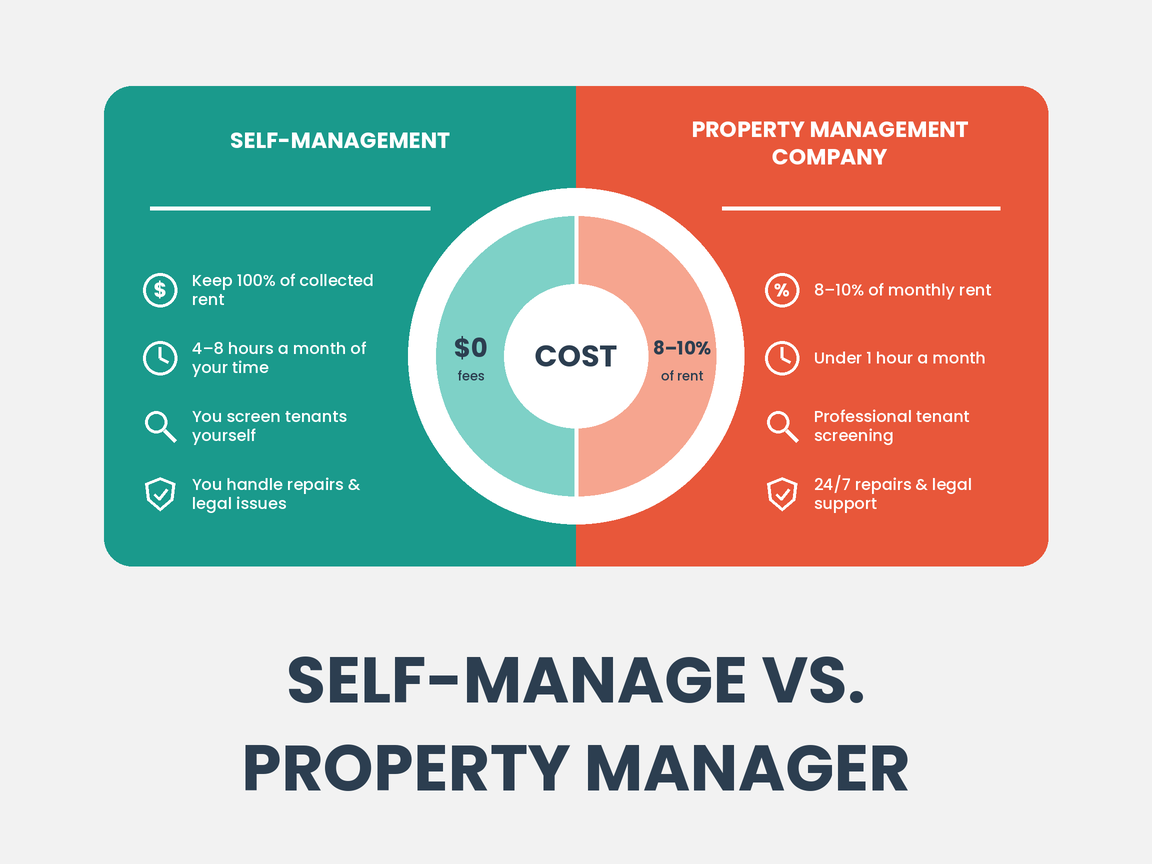
Understanding landlord vs. property manager responsibilities starts with a clear list of what each option includes. The breakdown below compares what each option actually covers, so you can match services against your own time budget and risk tolerance.
What Self-Management Involves
- Direct landlord control over rent pricing strategy and lease term negotiation
- No monthly property management fees, so you keep 100% of collected rent
- Full access to tenant communication and maintenance requests, with no middleman delays
- Responsibility for Indiana landlord-tenant law compliance, including notice periods and deposit rules
- Direct relationships with contractors, which avoids the roughly 10% maintenance markup most management companies add to vendor invoices
Property Management Company Inclusions
- Tenant screening and placement, typically including credit, criminal, and eviction history checks
- Rent collection and rental property accounting, often through an owner portal with monthly statements
- Maintenance coordination through property management software, with 24/7 emergency dispatch
- Eviction process handling and lease enforcement, including court filing assistance in Marion County
- Fair Housing Act compliance oversight, reducing the owner’s exposure to discrimination claims
Extras Not Typically Included
Most property management contracts exclude major renovations, HOA dispute resolution, and landlord insurance claims processing. Real estate investors should confirm these exclusions before signing. Some Indianapolis companies also charge separately for project management, annual inspections, tax-season bookkeeping, or eviction court representation beyond basic filing. Before comparing two companies side by side, always request an itemized fee schedule, not just the headline management percentage. Also check for early termination fees in case you switch companies or go back to self-managing.
Cost Breakdown: Property Management Fees in Indianapolis Explained
In 2026, Indianapolis property management company fees typically follow this structure:
- Monthly management fee: 8%–10% of collected rent, with some companies charging up to 12%
- Tenant placement (leasing) fee: 50%–100% of one month’s rent for new leases
- Lease renewal fee: $150–$300 per renewal, often around $195
- Maintenance markup: around 10% on vendor invoices
- Project management fee: around 10% on larger repairs or rehabs
- Setup or onboarding fee: $95–$300 one-time charge for new owners
Self-management costs less in cash but more in hours. Local property management companies estimate that a single-family rental in Marion County requires 4–8 hours per month of landlord time for rent collection, maintenance requests, and tenant communication.
For a $1,500/month rental, a 10% management fee equals $150 monthly, or $1,800 annually. For a three-property portfolio averaging $1,400/month per unit, the same 10% rate totals roughly $5,040 per year. Many owners don’t calculate that figure until tax time.
Run a simple comparison: if self-managing saves you $1,800 a year but takes 48–96 hours (4–8 hours a month), your effective hourly rate is roughly $19–$38. Compare that to your regular income or the opportunity cost of your time before deciding.
Security Deposit and Lease Agreement Handling
Under Indiana Code § 32-31-3-12, landlords must return the security deposit, minus an itemized list of deductions, within 45 days. The clock starts after the lease ends, the tenant returns possession, and the tenant provides a written forwarding address. Property managers typically include this in their standard service. Self-managing landlords must track deadlines manually using property management software or spreadsheets. Missing the 45-day window can make a landlord liable for the full deposit plus the tenant’s reasonable attorney fees, so calendar reminders are essential for self-managers.
Expected Benefits & ROI Analysis
Rental property ROI depends heavily on vacancy and tenant turnover, not just monthly fees. Marcus & Millichap forecasts Indianapolis-area apartment vacancy to fall to about 4.2% in 2026, a third straight annual decline. Vacancy still varies by neighborhood and property condition, and older homes with more maintenance needs tend to see more turnover.
Benefits of Hiring a Property Manager
- Faster tenant placement reduces vacancy-related income loss, often filling units 1–2 weeks sooner than self-managed listings
- Professional lease enforcement lowers legal exposure during disputes or non-payment cases
- Less landlord stress and time commitment, which is especially valuable for owners with full-time jobs
- Access to the management company’s vendor network for maintenance, often with negotiated bulk rates
- Consistent rent collection that reduces late payments through automated reminders and online portals
Benefits of Self-Managing Rental Properties
- Higher net rental income, since you keep the 8%–10% of gross rent that would otherwise go to management fees
- Direct relationships with tenants, which can improve retention and reduce turnover-related vacancy
- Full control over rent pricing and lease terms, including custom clauses for pets or parking
- Faster repair decisions, with no approval request routed through a management company
Property management pros and cons ultimately come down to a trade-off: cash flow versus time and risk. A property manager who reduces vacancy by even 2 weeks per year can offset a large share of the annual fee on a typical Indianapolis rental. For example, two fewer vacant weeks on a $1,500/month unit saves about $700 in lost rent, which is nearly 40% of the $1,800 annual management fee on that property.
Who Should Self-Manage vs. Who Should Hire a Property Manager
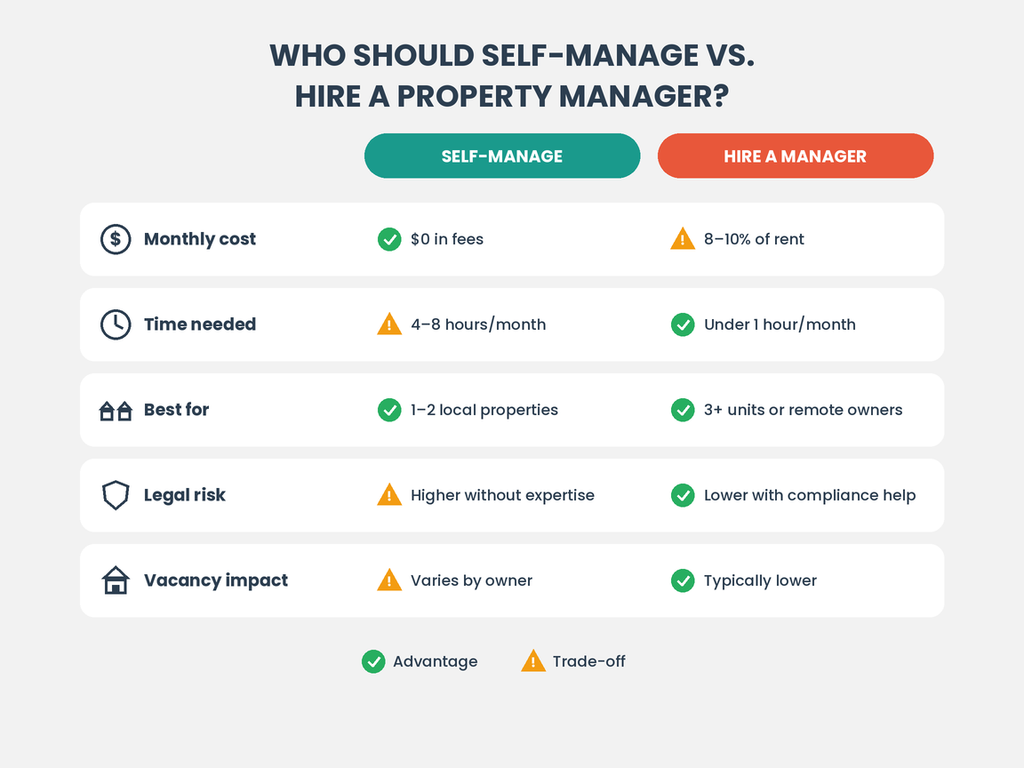
Self-Management Fits These Landlords
- Owners with 1–2 rental properties who live in Marion County
- Retired or semi-retired landlords with flexible schedules and daytime availability for showings
- Landlords comfortable with Indiana landlord-tenant law and the eviction process, or willing to learn them
- Owners who enjoy hands-on property maintenance and have reliable contractor contacts
- Landlords with below-average turnover, meaning fewer vacancies to manage each year
Signs You Need a Property Manager
- You live outside Indianapolis and need to manage rental properties remotely
- You own three or more units across different neighborhoods, which makes self-coordination inefficient
- You’ve had repeated tenant turnover or late rent issues in the past 12 months
- You lack time for tenant screening or lease enforcement because of a demanding job or family obligations
- You’re expanding your rental portfolio quickly and need scalable systems
- You’ve faced a contested eviction before and want professional legal coordination going forward
Alternatives to Full Self-Management or Full-Service Property Management
Outsourcing property management doesn’t have to be all-or-nothing. Several hybrid models let Indianapolis landlords choose their own balance between cost savings and convenience.
- Tenant placement only: Pay a property manager just for tenant screening and lease signing, often 50%–75% of one month’s rent, then self-manage day-to-day operations.
- Software-assisted self-management: Use property management software for rent collection, maintenance tracking, and accounting without hiring staff, typically for $20–$50 per month.
- Part-time maintenance support: Hire a local contractor or handyman service for maintenance requests only, and keep control of leasing and rent collection.
- Seasonal outsourcing: Self-manage most of the year, and hire a property manager temporarily during extended travel or illness.
For landlords still comparing options, resources like self-manage vs property manager breakdowns can help clarify which model fits a given portfolio size and risk tolerance.
Final Verdict: Is Hiring a Property Manager Worth the Cost?
| Factor | Self-Management | Property Manager |
|---|---|---|
| Monthly Cost | $0 (time cost only) | 8%–10% of rent |
| Time Commitment | 4–8 hours/month | Under 1 hour/month |
| Best For | 1–2 local properties | 3+ units or remote owners |
| Legal Risk Exposure | Higher without expertise | Lower with compliance support |
| Vacancy Rate Impact | Variable | Typically lower |
| Annual Cost on $1,500 Rent | $0 cash, 48–96 hours | ~$1,800 (plus leasing and renewal fees) |
Is self-managing rental property worth it? Yes, if you own a small number of nearby properties, understand Indiana landlord-tenant law, and have time for tenant screening and maintenance coordination.
Is hiring a property manager worth the cost? Yes, if you prioritize passive income, own multiple units, or live outside Indianapolis.
Indianapolis Landlord Tips Before Deciding
- Calculate your effective hourly rate for self-managing and compare it to the management fee.
- Read reviews for at least three Indianapolis property management companies before signing a contract.
- Confirm that Fair Housing Act training is part of the property manager’s screening process.
- Check whether landlord insurance requirements differ for self-managed and professionally managed rentals.
- Negotiate management fees based on your portfolio size, not just the advertised rate.
- Ask for a sample monthly owner statement before signing to confirm the reporting is clear.
Frequently Asked Questions
How much does a property manager cost in Indianapolis?
Indianapolis property managers typically charge 8%–10% of monthly rent, plus a tenant placement fee of 50%–100% of one month’s rent for new leases. Renewal fees often run around $195.
Can I switch from self-management to a property manager mid-lease?
Yes. Most Indianapolis property management companies can take on an existing tenant and lease. They transfer rent collection and maintenance responsibilities without requiring a new lease.
Does self-managing increase my legal risk in Indiana?
Only if the landlord is unfamiliar with Indiana landlord-tenant law. Key rules include the 45-day security deposit deadline, the default 10-day notice for nonpayment of rent when the lease doesn’t set one, and Fair Housing Act obligations.
Is a hybrid model cheaper than full-service management?
Hybrid models, such as tenant-placement-only service, cost less than full-service management. However, they shift ongoing rent collection and maintenance responsibilities back to the landlord.
Rental property profitability depends on minimizing vacancy, enforcing leases consistently, and staying compliant with Indiana rental property laws. Whether you self-manage or hire a property management company, the right choice is the one that fits your available time, portfolio size, and tolerance for landlord responsibilities.